
CONSTRUCTION MANAGEMENT | BUILDING & INFRASTRUCTURE WORKS
Loss & Expense Claims - Recover Prolongation & Disruption Costs
Delayed or Disrupted Through No Fault of Your Own? Claim the Costs Back
When a project overruns or gets disrupted because of someone else's failure, delayed information, late access, instructed changes, it's usually the subcontractor who absorbs the extra cost. Extended time on site, idle labour, extra supervision, none of that is free, and you shouldn't be the one paying for it.
Loss and expense claims exist precisely for this. Done properly, with the right records and the right valuation, they can recover a substantial amount. Done badly, or not submitted at all, that money is simply lost.
“Richard proved to be extremely knowledgeable and proficient in resolving our financial problem with a prominent, nationwide, but particularly difficult Client. His efficiency in dealing with the situation prevented the exacerbation of further problems, allowing a swift and successful outcome for our Company. We would have no hesitation in recommending his expertise to anyone in a similar situation."
– David Cook. M.D., H. Smith Electrical
Solution /
Process /
Agreement /
Testimonials











What Loss & Expense Covers
Loss and expense is the mechanism for recovering the direct financial loss caused by matters that are, contractually, not your fault, things like delayed instructions, late access to the site, variations, or disruption caused by the main contractor or other trades.
It typically covers costs such as extended preliminaries, idle plant and labour, additional supervision time, and increased costs caused by the delay itself, for example if material prices moved during the extended period. It doesn't cover delay that's your own responsibility.

JCT vs NEC Entitlement
The route to recovery depends heavily on your form of contract.
Under JCT contracts, loss and expense is usually claimed under the relevant clause once you've given notice that regular progress has been, or is likely to be, materially affected. You then need to submit the application with supporting information for the ascertainment of the amount.
Under NEC contracts, the mechanism works through compensation events. Instead of a separate loss and expense claim, you notify a compensation event and submit a quotation showing the effect on cost and time. Timing is stricter under NEC, notices generally need to be raised within a set number of weeks of becoming aware of the event, or you can lose entitlement entirely.
Getting this distinction right matters. Treating an NEC contract like a JCT one, or missing an early warning notice, is one of the most common ways subcontractors lose entitlement they'd otherwise have had.

Start The Process

Prolongation vs Disruption
These are often used interchangeably, but they're not the same thing, and a claim usually needs to address both separately.
Prolongation is the cost of the project simply running longer than planned, extended site overheads, supervision, plant hire, and so on, calculated over the additional period.
Disruption is the loss of productivity or efficiency caused by the disrupting event, even where the overall programme hasn't necessarily been extended. It's usually harder to prove and needs a different method of valuation, often based on measured productivity loss rather than simply extended time.
Records You Need
Claims live or die on evidence. The records that matter most are:
- Programme information, both as-planned and as-built
- Site diaries and daily records showing what actually happened and when
- Correspondence, instructions, and any early warning or notice you issued
- Labour and plant allocation records for the affected period
- Photographic evidence where relevant
If you're not already keeping this level of record on site, it's worth starting now, even before a claim is on the table. It's far easier to build a claim from good contemporaneous records than to reconstruct events months later from memory.

How We Build & Value the Claim
RJH prepares the claim from the ground up: establishing entitlement under your specific contract, pulling together the supporting records, and producing a valuation that a main contractor's QS will actually engage with rather than dismiss out of hand.
Where the claim needs to go further, whether that's negotiation, mediation or adjudication, we run that process too, so you're not handing it off to someone new partway through.
Worked Example
To give a sense of scale: a subcontractor delayed by eight weeks due to late main contractor information might reasonably claim extended site overheads (say, a site manager and welfare costs for that period), plant standing time, and increased costs where material prices rose during the extension. On a mid-size project, that kind of claim can run into tens of thousands of pounds, money that's very rarely paid automatically and almost always requires a properly evidenced application to recover.
This is illustrative only. Every claim is different, and the actual value depends entirely on your specific records and contract.
Start The Process

Get Your Claim Valued
If you've been delayed or disrupted and haven't submitted a claim, or you're not confident the one you've submitted is being taken seriously, get it reviewed properly.
Richard Mole
Arthur Wilby
David Cook
"Our goal is to ensure that you obtain the building work that you want, on time and within budget, without suffering any adverse impact on your business."
- You don’t really understand the construction process and worry about getting it wrong
- You fear that costs for your project might exceed your budget or spiral out of control
- You’re concerned about poor quality work, ‘cowboy builders’, and ultimately not getting the facility which your organisation needs
- You worry there could be an adverse impact on your existing business
- The regulations, red-tape, and risks involved seem like insurmountable barriers
- Design of your construction project (via the selection and appointment of appropriate professionals)
- Planning Permission, Building Regulations, and CDM Regulations
- Quantity Surveying - Costing of the proposed construction works and Cost Management throughout the design and construction processes
- Drawing up Tender documents and obtaining competitive tenders from suitably qualified Contractors
- Advising on and drafting Contracts for the Construction works and for design Consultants.
- Project or Construction Management during the construction phase
- Employer’s Agent role
- Principal Designer role
- Value Engineering
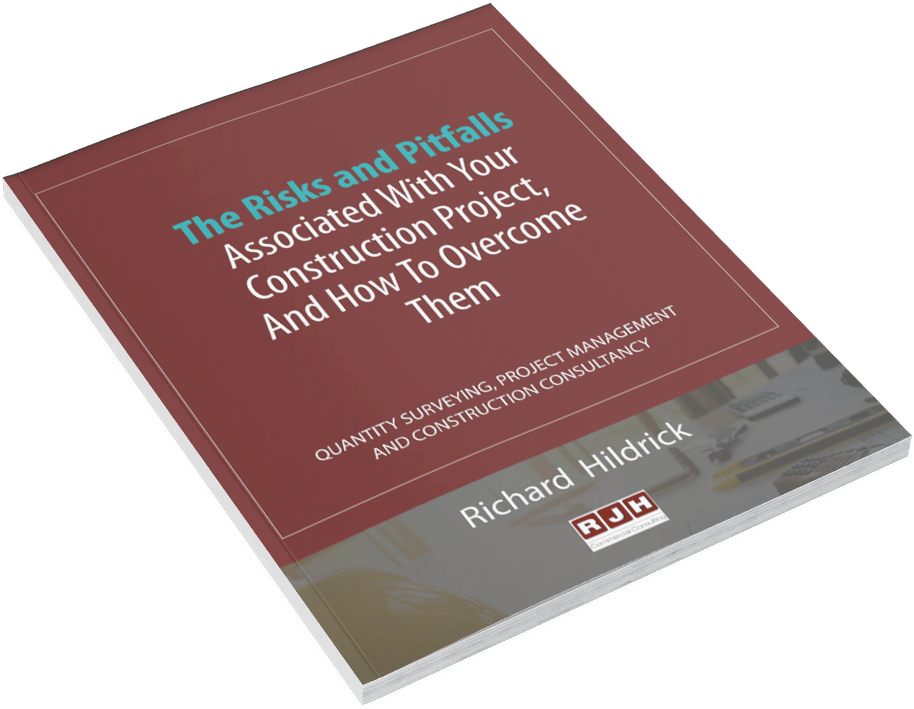
The Risks and Pitfalls Associated With Your Construction Project, And How To Overcome Them
- How to navigate the various application, approval and sign‐off processes at the relevant stages of your project.
- Who to turn to for help when it comes to cost planning a project.
- What you need to know to draw up a water-tight contract.
- How to cover yourself when it comes to rectifying defects.